
Validated Doesn’t Mean AI-Free
In a pharmaceutical animal study, on a GMP manufacturing line, or inside a clinical program, nobody asks whether a system is impressive. The questions are harder and older: What exactly is it for? Does it behave the same way every time it matters? Who did what, and when? And can you reconstruct all of it years later, in front of an inspector?
Organizations in these environments already have systems that answer those questions: LIMS, ELN, QMS, document management. They are validated, change-controlled, and trusted. Nobody is asking to replace them. What teams want is AI’s real strengths, reading, classifying, summarizing and extracting, brought to the work around those systems, without putting the validation they’ve earned at risk.
That is the job appRules is built for: an add-on layer that sits beside your validated systems and lets GuardRailed AI do useful work inside a process you control.
Heavily validated doesn’t mean AI-free. It means AI with receipts.
What the Regulators Are Signaling
The expectations are not new, but they are now being applied to AI. The foundations:
- GLP, 21 CFR Part 58. Nonclinical studies, including animal studies, must keep the original observations and records that make it possible to reconstruct and evaluate the study. The Study Director is accountable, and an independent quality assurance unit checks the work.
- 21 CFR Part 11. Electronic systems must be validated for accuracy, reliability and consistent performance, including the ability to discern invalid or altered records. Access is limited to authorized individuals, and secure, time-stamped audit trails record who created, changed or deleted what.
- ALCOA+. Data should be attributable, legible, contemporaneous, original and accurate, and also complete, consistent, enduring and available.
And the newest signals are about AI directly:
- EU GMP Annex 22 (draft, published for consultation in July 2025). For critical GMP applications, only static, deterministic models are in scope. Generative AI and large language models are kept out of critical decisions, and allowed in non-critical uses with a human in the loop.
- FDA draft guidance (January 2025) on AI to support regulatory decision-making for drugs and biologics proposes a seven-step, risk-based credibility framework built around the model’s context of use.
- FDA and EMA joint principles (January 2026). Ten principles for good AI practice, including human-centric design, a risk-based approach, adherence to standards such as GxP, clear context of use, data governance and documentation, and lifecycle management. They span nonclinical, clinical and manufacturing work.
Read together, the thread is clear: define what the AI is for, keep critical decisions deterministic and accountable, and document everything.
AI Proposes, Validated Logic Decides
That thread leads to one design. Let AI do what it is good at, and keep the decision, the write and the record in deterministic, inspectable hands. In appRules every AI step follows the same shape:
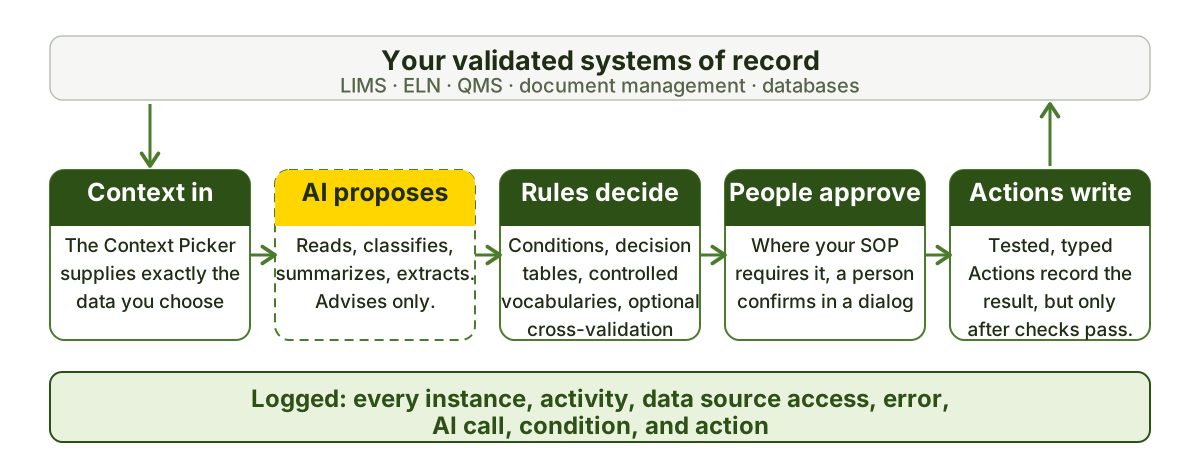
The model advises. It reads the study notes, the batch record, or the incoming document and proposes a classification, a summary, or an extraction. Then the process takes over. Conditions and decision tables, rules your quality team can read, decide whether the proposal is acceptable. Controlled vocabularies reject terms that don’t belong. Where your SOP calls for a person, a workflow dialog puts one in the loop. And only then do typed, tested Actions write the result. No model writes to your systems on its own.
The context of use is no longer a document that describes the system. It is the workflow itself: a defined purpose, defined inputs from the Context Picker, defined checks, and a defined outcome.
Features Built for Validated Work
Several appRules capabilities map directly onto what validated environments care about:
Validated as You Build
Every property is validated as you configure it, Validate Workflow runs on demand, and every run is validated automatically first: the scheduler won’t run an invalid workflow. See GuardRailed Automation.
Nothing Written Until It Checks Out
Every field is validated and controlled vocabularies are enforced on every read and write. Only validated Actions execute, and post-conditions are checked before anything is written.
A Record Built for Inspection
Tamper-proof logs capture activities, data sources, AI model calls and tokens, Condition results, and Action results, with CSV export. Answer an auditor with evidence, not reconstruction. See Logging & Statistics.
Valid and Invalid, Counted
Every Action in every run records how often it executed, how many results were valid, and how many were not. Problems surface immediately, and Conditions can respond while the run is still going. Read the Actions white paper.
Deterministic Judgment Across Models
Optionally ask several models the same question and let deterministic rules, not another model, decide what the answers mean, with a fail-safe for when they disagree. See Model Cross-Validation.
Locked Down and Under Change Control
The Secure button locks sensitive activities, connections, data source metadata and settings so only the right credential can view or change them. Role-based access and check-in/check-out version control keep workflow changes accountable.
Runs Where Your Validated Systems Run
Install on your own servers or in the cloud you choose, and use local models that never leave your network. The logs show which model answered which question. See System Operations.
Built to Be Extended
Source-code access means your developers can add what your quality system needs. See below.
When Your Quality System Needs Something More
Every validated site is different. Each has its own SOPs, naming conventions, approval chains and signature requirements, and no product can ship all of them. So appRules ships its source.
Your developers, working in Visual Studio, can add what a site needs: a custom Action, an extension workflow activity, an electronic-signature step, a connector to your QMS. The new building block appears in the designer like any other, so the no-code builders can use it right away. There is no waiting on a vendor roadmap, and every change goes through your change control, the way you already work. See No Code, Low Code, and Source Code.
What It Looks Like in Practice
Picture three places where this fits:
- A GLP animal study. AI reads free-text clinical observations and necropsy narratives and proposes standardized terms, for example controlled terminology such as CDISC SEND. Controlled vocabularies and Conditions accept or reject each proposal, the study team confirms, and typed Actions write the accepted record. QA sees what the AI proposed, what the rules decided, and who approved it.
- A GMP batch record or deviation review. AI summarizes the record and flags anomalies. Deterministic rules route each item by severity and product impact, and qualified reviewers decide: the human-in-the-loop pattern the Annex 22 draft expects around generative AI.
- Regulatory and clinical document intake. The AI File and Folder Agents classify incoming protocols, consent forms and reports and route them with a reason for every decision.
Questions Worth Asking
Whatever AI system you consider for a validated environment, put these questions to it:
- What is the context of use for every AI step, and where is it defined?
- Which decisions are made by deterministic logic your QA team can read?
- What gets written to the system of record, by what, and what is checked first?
- Can you reconstruct what the AI saw, what it proposed, and what happened next?
- Who can change a workflow, and how is that change controlled?
- Where does it run, and where do the models run?
- When it doesn’t fit your process, can you extend it yourself?
Want the full guide? Read Beyond the Demo: How to Evaluate an AI Automation Platform. Related reading: What Is an AI Harness, and Why Does Your Enterprise Workflow Need One? and Where Does appRules Fit in the Agentic Enterprise Stack?
The Short Version
Validated environments don’t need AI that is trusted. They need AI that is bounded: a defined purpose, deterministic decisions, a person where the procedure requires one, typed Actions that write, and a record of all of it. appRules adds that beside the systems you have already validated, and when your process needs more, you have the source.
See GuardRailing at Work
Explore the GuardRailed Automation framework, or talk to us about your validated environment.